Introduction: Navigating the Next Frontier of Work
The integration of artificial intelligence into the business landscape represents more than a technological upgrade; it signals a fundamental paradigm shift. This is the era of AI in workforce transformation, a period defined by both unprecedented opportunity and significant organizational challenges. The narrative is moving beyond simple automation to the sophisticated integration of AI as a collaborative partner—a digital colleague. For leaders, particularly Chief People Officers, the primary challenge is no longer if AI will change work, but how to strategically manage this evolution. With 82% of business leaders viewing 2025–2026 as a pivotal turning point for AI-powered collaboration, the time for strategic action is now. A poorly managed integration can lead to disengagement and inefficiency.
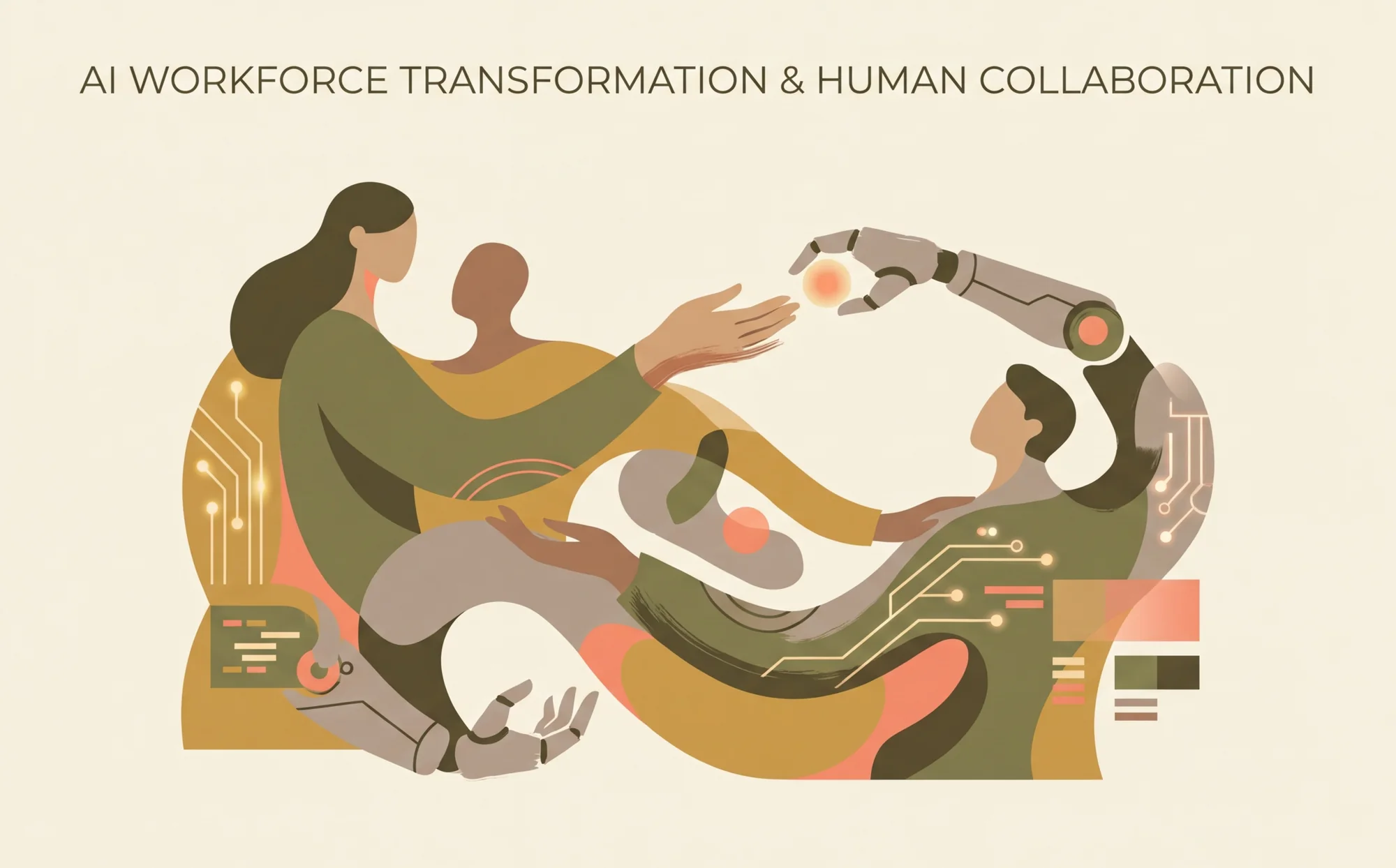
Successfully navigating this landscape requires a deliberate and human-centric approach. It demands that we move past the simplistic fear of job replacement and embrace a more nuanced vision of augmentation and collaboration. The core of a successful AI in workforce transformation is this very mindset shift. This article provides a strategic framework for leaders aiming to spearhead this change, offering actionable insights into designing roles with AI, fostering effective human-AI collaboration strategies, and leading the necessary organizational redesign AI demands.
The journey toward a seamlessly integrated workforce is complex, but the rewards—enhanced productivity, breakthrough innovation, and a more empowered human workforce—are immense. We will explore the critical components of a successful transformation, providing a playbook for building an organization where human talent and artificial intelligence achieve more together than either could alone.
Shifting from Replacement to Augmentation: The Core of AI in Workforce Transformation
The prevailing anxiety surrounding AI impacts on job roles often centers on obsolescence. However, leading research suggests a different reality. A recent study found that 80% of the U.S. workforce could have at least 10% of their work tasks affected by the introduction of Large Language Models, while 19% of workers may see 50% of their tasks impacted. This data does not signal an end to human work but rather a significant evolution. The most forward-thinking leaders understand that the true value of AI in workforce transformation lies in augmentation—freeing human workers from routine, data-intensive tasks to focus on uniquely human skills.
This strategic reframing is the foundation of any effective Chief People Officers AI strategy. Instead of viewing AI as a tool to cut headcount, it should be seen as a capability multiplier. AI can analyze vast datasets in seconds, identify patterns invisible to the human eye, and manage complex logistical operations with perfect consistency. This allows human employees to dedicate their time to strategic thinking, creative problem-solving, complex communication, and empathetic leadership. This fundamental shift is the most critical first step in any successful workforce evolution.
A Strategic Framework for Designing Roles with AI
To realize the benefits of augmentation, organizations must proactively engage in redesigning roles. A reactive approach risks creating fragmented workflows and disengaged employees. A structured methodology for designing roles with AI is essential for a smooth and effective AI in workforce transformation. This framework involves three key steps:
Task Auditing and Deconstruction
The first step is to deconstruct existing job roles into their core tasks. This granular analysis moves beyond broad job titles to understand the specific activities an employee performs daily. Each task can then be categorized along a spectrum: is it repetitive and data-driven (a prime candidate for AI) or does it require creativity, critical judgment, and interpersonal nuance (where humans excel)?
Identifying AI Augmentation Points
With a clear task inventory, leaders can pinpoint specific opportunities for AI colleagues integration. For instance, a financial analyst's role can be deconstructed into data gathering, report generation, anomaly detection, and client advising. AI is exceptionally well-suited for the first three tasks, while the human analyst provides irreplaceable value in the fourth. This is a practical example of designing roles with AI to create a symbiotic relationship.
Redefining Human Value
Once AI takes over certain tasks, the human role must be redefined to focus on higher-value contributions. This involves an emphasis on upskilling and reskilling in areas like strategic analysis, ethical oversight, creative innovation, and collaborative leadership. The success of any AI in workforce transformation depends on elevating the human contribution, not diminishing it.
Cultivating Effective Human-AI Collaboration Strategies
Theory must translate into practice. Establishing effective human-AI collaboration strategies is where the true potential of this new work paradigm is unlocked. This requires creating clear protocols, fostering trust in AI-driven insights, and designing workflows that treat AI as a genuine team member.
A successful AI in workforce transformation is built on these practical integrations. Consider these examples:
- The AI-Powered Marketing Team: A marketing team integrates an AI colleague that continuously analyzes market trends, competitor activities, and real-time campaign performance data. The AI generates predictive models for customer segmentation and recommends optimal budget allocations. This frees the human marketers from hours of data analysis, allowing them to focus on crafting compelling brand narratives, developing creative concepts, and building strategic partnerships. The AI handles the "what," so the humans can master the "why" and "how."
- The Augmented Healthcare Administrator: In a hospital setting, an AI system manages patient scheduling, bed allocation, and supply chain logistics, optimizing for efficiency and reducing wait times. This allows human administrators to focus on patient communication, staff support, and handling complex, emotionally charged situations that require empathy and nuanced judgment. This is a powerful demonstration of AI colleagues integration improving both operational efficiency and the human experience. This model is central to the broader goals of a modern workforce evolution.
Atharvix Says: The question isn't how many jobs AI will replace—it's how to design roles where human judgment and AI capability create outcomes neither could achieve alone.
The Imperative of Organizational Redesign for AI Integration
Simply designing roles with AI in isolation is insufficient. To fully capitalize on this shift, a comprehensive organizational redesign AI strategy is required. This involves re-evaluating team structures, communication channels, performance metrics, and the underlying corporate culture. The entire ecosystem must evolve to support a hybrid human-AI workforce, a key tenet of AI in workforce transformation.
Fostering a Culture of Continuous Learning
The rapid pace of technological change means that skills have a shorter half-life than ever before. Organizations must build a culture that champions lifelong learning, curiosity, and adaptability. This includes investing in robust training programs focused not just on how to use new AI tools, but also on developing the critical thinking and analytical skills needed to interpret and challenge AI-generated outputs. This cultural shift is a non-negotiable part of a successful transformation and requires robust Change Management Best Practices.
Establishing New Governance and Ethical Frameworks
The integration of AI introduces new complexities around data privacy, algorithmic bias, and accountability. A robust AI in workforce transformation must include the development of clear ethical guidelines and governance structures. Who is responsible when an AI makes a mistake? How do we ensure that AI tools are used fairly and transparently? Answering these questions proactively builds trust and mitigates risk.
The CHRO's Playbook: Leading AI Colleagues Integration
Chief People Officers are the strategic architects of this new workforce. The CHRO's role transcends traditional human resources functions; it is about championing the human element within a technologically advancing organization. An effective Chief People Officers AI strategy is the linchpin of a successful AI in workforce transformation.
The CHRO must lead the charge in several key areas. First is communication: articulating a clear and optimistic vision for the future of work that addresses employee fears and highlights opportunities for growth. Second is change management: implementing the structural and cultural shifts necessary for successful AI colleagues integration. Finally, it involves developing new metrics for success that measure not just productivity gains, but also employee engagement, well-being, and the effectiveness of human-AI collaboration. This level of foresight is a core component of Strategic Workforce Planning. The leadership demonstrated during this technological shift will define the organization's future. This journey is a marathon, not a sprint, and requires steady, adaptive leadership.
Conclusion: Architecting the Future, Together
The integration of artificial intelligence into our work lives is not a distant future; it is the present reality. The success of this transition hinges on our ability to move beyond a technology-centric view and adopt a human-centric approach to AI in workforce transformation. It requires a strategic, deliberate, and empathetic approach to rethinking how work gets done. The process is ultimately about unlocking new levels of human potential.
By focusing on augmentation over replacement, proactively redesigning roles, and cultivating a culture of continuous learning, leaders can build organizations that are not only more efficient and innovative but also more resilient and human. This is the central promise of a well-executed AI in workforce transformation.