Revolutionizing Patient Care: How AI in Hospital Triage is Transforming Hospital Networks
How can healthcare systems alleviate the immense pressure on their emergency departments while elevating the standard of care? For hospital administrators, this question is paramount. The constant struggle to manage patient flow efficiently, especially at triage, creates significant bottlenecks that impact outcomes, strain resources, and diminish patient satisfaction.
The traditional triage process relies heavily on human assessment under high-stress conditions, introducing potential for variability and delay. As hospital networks expand, the limitations of this model become increasingly apparent. A new paradigm is required—one that leverages technology to augment clinical expertise and create a more responsive healthcare environment. This is where the strategic implementation of AI in hospital triage emerges as a transformative solution.
This article explores the profound impact of AI in hospital triage on modern healthcare. We will delve into the mechanics of these intelligent systems, analyze their benefits, and outline key considerations for successful implementation. By understanding these powerful patient flow optimization tools, your organization can chart a course toward a more efficient future for emergency care.
Overcoming the Triage Bottleneck with AI
The emergency department (ED) waiting room is often the epicenter of a hospital's operational pressures. Triage nurses perform a critical function, rapidly assessing patients to determine the urgency of their condition. This manual process, however, is susceptible to challenges like incomplete information and cognitive overload, which can delay care for the most critical patients.
An automated patient triage system powered by artificial intelligence directly addresses these vulnerabilities. Instead of replacing clinical judgment, these systems act as a powerful decision-support tool. They process vast amounts of data in real-time—far more than a human can simultaneously consider—to provide an objective, data-driven assessment of patient acuity. This technological augmentation helps standardize the initial evaluation, reducing variability and ensuring resources are directed where they are most needed. The core value of AI in hospital triage lies in its ability to bring consistency and speed to this crucial first step.
How AI in Hospital Triage Works: From Data to Decision Support
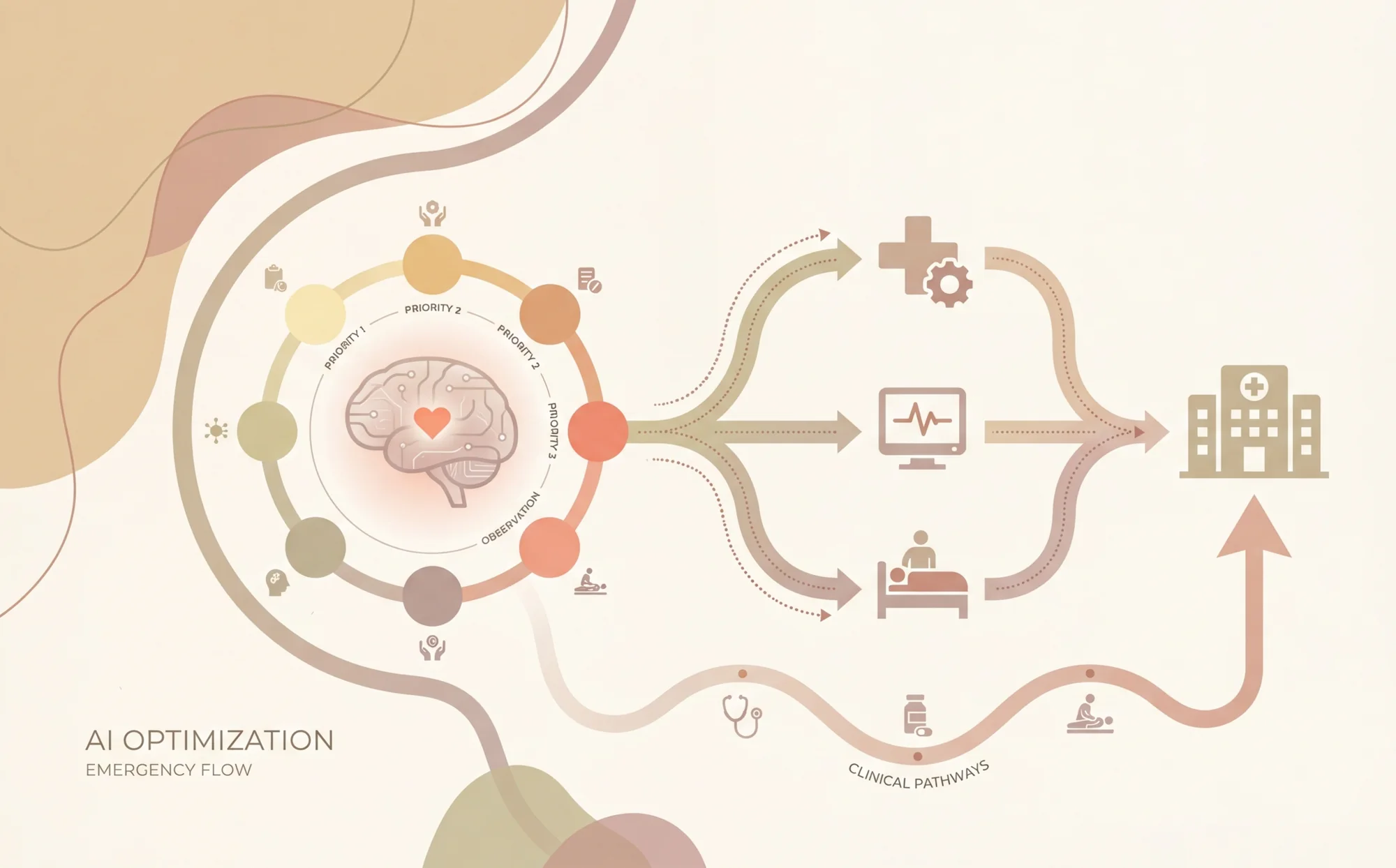
At its heart, an AI in hospital triage platform is a sophisticated analytical engine. It synthesizes information from disparate sources to build a comprehensive, real-time picture of a patient's condition, enabling clinicians to make faster, more informed decisions.
Data Ingestion and Predictive Analysis
The process begins as the system ingests data from multiple streams, including electronic health records (EHRs), real-time vital sign monitors, and patient-reported symptoms. This comprehensive data set provides the foundation for the system's predictive models. Using machine learning algorithms trained on millions of historical cases, these emergency department AI solutions identify subtle indicators of high-risk conditions that might otherwise be missed.
Risk Stratification and Resource Allocation
Once data is analyzed, the system assigns a dynamic risk score or acuity level to each patient, updating it as new information becomes available. For hospital leaders, the power of AI in hospital triage extends to resource management. The system can predict which patients are likely to require admission, specific imaging, or an ICU bed, allowing for proactive resource allocation and smoother hospital network management AI. This foresight helps minimize delays and optimize the use of critical hospital assets.
The Tangible AI Triage Benefits for Hospital Networks
Adopting emergency department AI solutions delivers measurable improvements in operational efficiency and patient care. Research indicates that AI-driven triage systems can reduce patient wait times in emergency departments by up to 20%, significantly improving satisfaction and clinical outcomes. This single metric highlights the profound potential of AI in hospital triage.
Enhanced Speed and Clinical Accuracy
One of the primary AI triage benefits is accelerating the decision-making process. By automating data collection and presenting a concise risk assessment, these systems free up clinicians to focus on patient care. For example, a large urban medical center that implemented an automated patient triage system to analyze paramedic data for incoming ambulance patients saw a significant reduction in door-to-provider times for critical cases like stroke and sepsis. The use of AI in hospital triage in this context directly translates to better patient outcomes.
Optimized Patient Flow and Reduced Wait Times
Effective AI in hospital triage directly combats ED overcrowding by creating a more predictable patient journey. By accurately forecasting patient needs and potential bottlenecks, the system helps manage departmental capacity. A regional hospital that deployed an AI in hospital triage platform was able to better anticipate patient surges and adjust staffing proactively, leading to a demonstrable reduction in patients who left without being seen. These patient flow optimization tools are essential for modern hospital management.
Key Considerations for Implementing Emergency Department AI Solutions
Transitioning to an AI-augmented workflow requires careful planning. A successful implementation of AI in hospital triage hinges on thoughtful integration, comprehensive staff training, and a commitment to ethical governance.
Integration with Existing Health IT Infrastructure
For any AI in hospital triage system to be effective, it must integrate seamlessly with the hospital's existing EHR. This ensures the AI has access to necessary patient data and its insights are available within the clinician's established workflow. A fragmented system requiring users to switch between applications creates new inefficiencies. To learn more, see our guide on Integrating AI with Existing EHR Systems. The goal of AI in hospital triage is to simplify clinical operations.
Staff Training and Clinical Validation
Building trust in the technology is critical for adoption. Clinicians must understand how the AI in hospital triage algorithms arrive at recommendations and view the system as a reliable partner. A phased rollout, where the AI initially serves as a "second opinion," can be an effective strategy. This allows the clinical team to validate the system's accuracy against their own judgment, fostering confidence and ensuring the responsible deployment of these advanced AI healthcare innovations. This collaborative journey must also address The Ethics of AI in Clinical Decision Support.
The Future of AI Healthcare Innovations in Patient Management
The application of AI in hospital triage is just the beginning of a broader transformation. The same principles of predictive analytics and automation can be applied across the entire patient care continuum. We are moving toward a future where hospital network management AI can dynamically balance patient loads across multiple facilities, preventing any single ED from becoming overwhelmed.
These emerging AI healthcare innovations will soon predict disease outbreaks, forecast staffing needs with incredible accuracy, and personalize patient communication at scale. The evolution of the automated patient triage system will integrate more deeply into a hospital's central nervous system. Strategic adoption of AI in hospital triage is the first step toward building this smarter, more connected healthcare ecosystem.
Conclusion
The evidence is clear: AI in hospital triage is a powerful catalyst for change in overburdened healthcare environments. By augmenting clinical expertise with data-driven insights, these systems address critical bottlenecks, paving the way for a more efficient, accurate, and patient-centric standard of care.
To summarize the key takeaways:
- Strategic Advantage: An automated patient triage system transforms the chaotic ED by introducing speed, objectivity, and predictive foresight into the initial patient assessment.
- Measurable Impact: The core AI triage benefits include significantly reduced wait times, optimized resource allocation, and reduced staff burnout, leading to better outcomes and operational efficiency.
- Thoughtful Implementation: Success depends on seamless EHR integration, robust clinical validation, and comprehensive staff training to build trust and ensure the technology enhances workflows.
As hospital networks navigate complex operational pressures, exploring these patient flow optimization tools is a strategic imperative. The journey toward an AI-enhanced care delivery model begins with a foundational investment in platforms that redefine the very nature of patient management.