Invisible Lifelines: How AI in Healthcare Supply Chain Directly Impacts Patient Recovery
The Unseen Link: From Hospital Stockroom to Patient Recovery
While a staggering 90% of hospital executives see supply chain management as a strategic priority, medication and supply shortages continue to plague health systems, costing U.S. hospitals an estimated $200 million annually per facility. This is not just a financial issue; it's a clinical crisis. The efficiency of a hospital's supply chain is an invisible but powerful determinant of patient care, directly influencing recovery times, safety events, and even mortality rates. The successful implementation of AI in healthcare supply chain is the most critical lever for transforming this operational challenge.
For too long, inventory management has been viewed as a back-office function, detached from frontline patient care. Traditional methods, reliant on manual counts and historical data, are fundamentally reactive. They fail to account for the dynamic nature of healthcare demand, leaving clinicians to discover a critical shortage at the worst possible moment. This paradigm must shift from reactive procurement to predictive, autonomous logistics—a transformation powered by advanced [clinical supply chain technology](Link to: Healthcare Logistics Solutions).
This article will dissect the profound connection between patient outcomes logistics and clinical success. We will explore how legacy systems create clinical risks and demonstrate how intelligent automation provides the solution. It is time to redefine the role of the supply chain from a logistical necessity to a strategic clinical asset.
The Clinical Cost of Inefficiency: Medication Shortage Impact and Patient Safety
The true cost of a disorganized supply chain is measured not in dollars, but in delayed procedures and compromised patient safety. When a necessary item is unavailable, the clinical workflow is disrupted, leading to a cascade of negative consequences. The medication shortage impact is particularly severe, with research indicating that drug shortages are associated with a significant increase in medication errors and adverse patient events. This reality underscores the urgent need for better inventory management in hospitals.
Consider a common scenario: a cardiac lab discovers it is short on a specific stent mid-procedure. The delay while staff search for a replacement not only increases procedural time and patient anxiety but also elevates the risk of complications. This is a direct failure of the supply chain. Inefficient systems contribute to these stockouts, which can extend patient stays by as much as 1.2 days, according to one study. This highlights how a robust strategy for AI in healthcare supply chain is not an option, but a necessity for modern healthcare delivery.
From Reactive to Predictive: A New Paradigm for Hospital Inventory Management
The fundamental flaw in traditional inventory management in hospitals is its reliance on historical data in a field that is constantly evolving. A hospital's needs can shift dramatically based on seasonal illnesses, local accidents, or public health emergencies. A system that only looks backward is destined to be caught unprepared. The required paradigm shift is a move toward a predictive model that leverages real-time data to anticipate needs before they become critical shortages.
This is where data analytics and machine learning become essential healthcare logistics solutions. By integrating data from various sources—such as electronic health records (EHR), admission and transfer systems, and public health data—predictive algorithms can forecast demand with remarkable accuracy. This evolution in clinical supply chain technology allows hospitals to prepare for a surge in influenza cases by increasing stock of antivirals and personal protective equipment weeks in advance. This forward-looking approach, enabled by a strategic application of AI, is the cornerstone of a modern clinical supply chain.
Introducing Agentic AI: The Future of Autonomous Healthcare Logistics
While predictive analytics is a significant leap forward, the next evolution is the implementation of autonomous, decision-making systems. Supply chain AI agents are intelligent, autonomous entities capable of managing complex logistical tasks without human intervention. These are not simple automation scripts; they are cognitive agents that can analyze data, model scenarios, and execute optimal decisions in real-time.
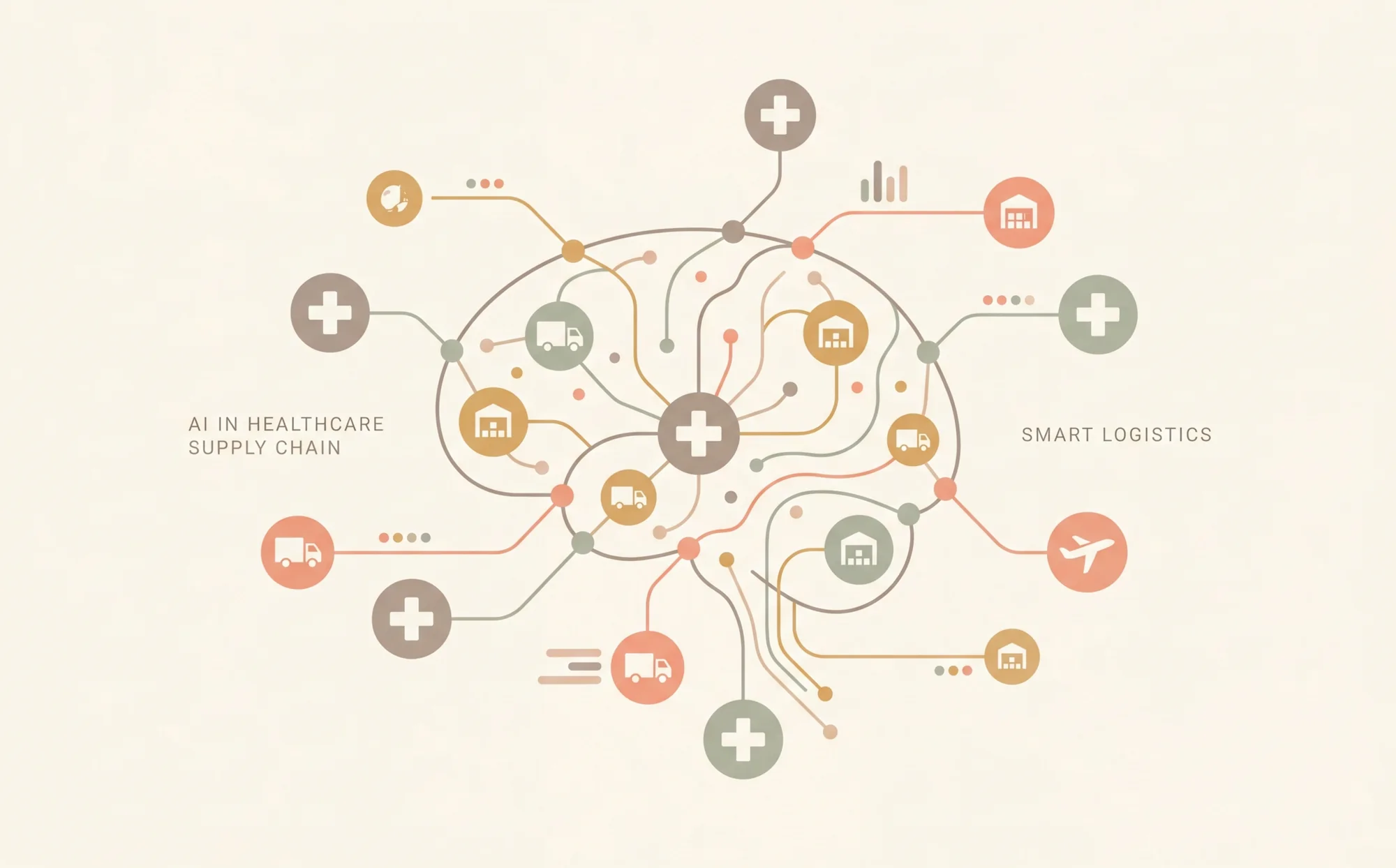
These agents operate 24/7, monitoring inventory levels, tracking supplier lead times, and analyzing consumption patterns at a granular level. When an agent predicts a future shortage of a critical medication, it can autonomously initiate a purchase order, verify delivery schedules, and even identify alternative suppliers if the primary source is unavailable. This proactive management transforms the entire system from a series of manual tasks into a self-regulating, resilient ecosystem powered by a sophisticated AI in healthcare supply chain.
Atharvix Says: When Bandages Become a Bottleneck: Agentic AI for Clinical Supply Chains
Inventory-Driven Care: The Hidden Variable in Patient Outcomes
Real-World Applications of AI in Healthcare Supply Chains
The theoretical benefits of AI in healthcare supply chain are being realized in practical applications that directly enhance patient care. These examples demonstrate the tangible impact of intelligent inventory management.
Optimizing Oncology Drug Management
An academic medical center implemented supply chain AI agents to manage its inventory of high-cost, short-shelf-life chemotherapy drugs. The agents analyzed patient scheduling data from the EHR to predict the exact number of doses needed each day, drastically reducing expensive waste from expired medications. More importantly, this system eliminated treatment delays caused by drug unavailability, directly improving the continuity of care for cancer patients.
Dynamic PPE Allocation During a Crisis
During a recent public health crisis, a multi-state hospital network used an AI in healthcare supply chain platform to manage its PPE inventory. The system monitored real-time admission rates and public health data to identify emerging hotspots. It then autonomously rerouted shipments of masks, gowns, and gloves to the hospitals with the most urgent need, preventing critical shortages and protecting frontline staff. The impact on patient outcomes logistics was immediate and measurable.
Overcoming Hurdles in Adopting Clinical Supply Chain Technology
Adopting a transformative technology like AI in healthcare supply chain is not without its challenges. Common hurdles include integrating disparate data systems, ensuring staff buy-in through effective change management, and justifying the initial investment. However, these obstacles are surmountable with a strategic approach.
Success hinges on selecting a scalable platform and committing to a phased implementation. Starting with a single department, such as the pharmacy or surgical services, allows an organization to demonstrate clear wins and build momentum. The return on investment for an AI in healthcare supply chain system is not measured solely in operational savings; it is realized in fewer safety events, shorter patient stays, and improved clinical outcomes—metrics that define the core mission of any healthcare provider.
Conclusion: From Cost Center to Clinical Partner
The healthcare supply chain is the circulatory system of a hospital; when it falters, every aspect of patient care is at risk. Moving beyond outdated, reactive processes is a clinical imperative. The integration of AI in healthcare supply chain redefines logistics, transforming it from a back-office cost center into an integrated, strategic partner in delivering exceptional patient care.
The evidence is clear: intelligent, predictive, and autonomous inventory management is directly linked to better patient outcomes logistics. By ensuring clinicians have the right supplies at the right time for the right patient, we fortify the front lines of medicine and build a more resilient healthcare system. The future of inventory management in hospitals is here, and it is powered by AI.
- Key Takeaways:
- Supply chain inefficiencies are a direct threat to patient safety and can lead to treatment delays, medication errors, and longer hospital stays.
Supply chain AI agentsoffer a proactive, autonomous solution, moving beyond simple prediction to intelligent, real-time decision-making.- Implementing AI in healthcare supply chain technology generates a powerful ROI measured in both financial savings and, more importantly, improved clinical outcomes.
The time for incremental improvements has passed. The health of your patients depends on the intelligence of your supply chain. Revolutionize your operations by exploring our [Healthcare Logistics Solutions](Link to: Healthcare Logistics Solutions) and discovering the core principles of [Agentic AI Technology](Link to: Agentic AI Technology).